
October 15, 2026 | Liturgical Year A
Twenty-ninth Sunday in Ordinary Time
- Isaiah 45:1, 4-6
- Psalm 80:9, 12-16, 19-20
- 1 Thessalonians 1:1-5b
- Matthew 22:15-21
Missionary Commentary
Missionaries are often sent to live and work in nations that are still trying to stabilize their democracies, or among people who have been forced to survive under autocratic and dictatorial regimes.
These are situations that are comparable with the complexity of living in Judah, a province of the Roman Empire, in Jesus’ time. Jesus is skilled, however, in avoiding the traps of his opponents, who try to force him to declare himself either in favor of paying the Roman tax (and angering the rebels among his people), or against paying the tax—which would lead to his arrest and probable execution by the imperial authorities.
The local Churches of various countries that host missionaries will often defend them in times of controversy and conflict, times stirred up by suspicious and oppressive regimes and their agents. I was proud of the Cardinal archbishop of Santiago, Chile’s capital, for his own declaration when two of our Columban Fathers were expelled from the country in 1983.
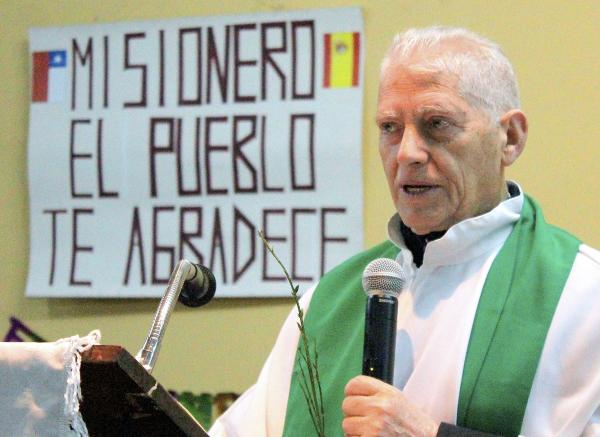
At a Mass in Chile, a missionary priest from Spain is bidden farewell as he returns home.
The dictatorship issued a statement that these “foreign agitators” were living in poor areas, and were threats to the security of the country by helping to form Christian communities in areas that the regime always regarded as hot spots of rebellion.
The Cardinal protested the decision, and responded, “There are no foreigners, in the Church!” We missioners from other countries, that is, were as welcome as any Chilean, and recognized as brothers and sisters of the one People of God.
Some years later, after democracy was peacefully restored in 1990, both Columban Fathers returned to Chile, enjoying joy-filled receptions and embraces. The deadly things of a petty Ceasar—torture, executions, exile–disappeared, while the things of a loving God—things like justice, truth and human dignity—received their due regard in the life of the people.
May we learn to occupy ourselves with the “things of God”, and to treat all people who live and contribute to our own country as members of our national family, providing them with paths to full integration.
Notes on the Readings
First Reading, Isaiah 45:1, 4-6
The inspired authors of this part of the Book of Isaiah envision the Lord as grasping Cyrus of Persia by the hand, as a legitimate king to preside over the restoration of Israel, around the year 550 before Christ.
Psalm 96:1, 3, 4-5, 7-8, 9-10
These verses are taken from an enthronement hymn with a missionary focus: God tells his Chosen People, “Tell his glory among the nations; among all peoples, his wondrous deeds,” and, “Give to the Lord, you families of nations.”
Second Reading: 1 Thessalonians 1:1-5b
Paul begins his letter to the Christian community in Thessalonica with a greeting that contains two important words: grace and peace—grace as the loving gift of God through Christ that allows us to begin to respond to Him, and a new reality of peace, both at this moment and into the future.
Gospel: Matthew 22:15-21
Matthew’s version of this controversy generally follows Mark’s version (Mk 12:13-17), but sharpens the opposition between Jesus and the Pharisees, with the latter slinking away at the end. We see clearly the skill Jesus employs in escaping his opponents’ trap, as well as his challenge to pay as much (and more) attention to “God’s things” as to “Caesar’s things.”
Notes and Commentary by Fr. Bob Mosher, a member of the Missionary Society of Saint Columban.